
A preservative that is wrong for your formulation does not announce itself. The batch passes QC, ships, and sits on a shelf looking perfect. Three months later a customer opens a jar with mould on the surface, or a cream that has gone thin and sour, and by then the whole production run is in the market.
The awkward part is that the preservative in that batch may have been dosed at exactly the right level. It simply could not work at the pH you put it in.
This guide covers six preservatives we supply: phenoxyethanol, methyl paraben, propyl paraben, sodium benzoate, potassium sorbate and calcium propionate. For each one it sets out the pH window, the temperature limits, the usual dose and what it is actually good at, so you can match the preservative to the product rather than the other way round.
Why the choice matters
Anything containing water can grow microorganisms. Creams, lotions, shampoos, liquid soaps, sauces, beverages, bread: all of them are, from a microbe's point of view, somewhere warm and wet with food in it.
Three things are at stake.
Consumer safety. Contaminated cosmetics have caused eye infections, skin infections and, in products used near broken skin, serious systemic infections. Pseudomonas aeruginosa is the one that keeps formulators awake: it thrives in water, tolerates many preservatives and can cause real harm. In food, inadequate preservation runs from spoilage through to genuine foodborne illness.
Product integrity. Long before anything becomes dangerous, microbial growth ruins a product. Emulsions split, viscosity collapses, colours shift, odours develop, pH drifts. Customers do not file a report; they just stop buying.
Commercial and legal exposure. A contaminated batch means a recall, destroyed stock, and a regulator asking how it happened. In Uganda, as in most markets, cosmetic and food products must meet national standards for microbiological quality, and you need to be able to demonstrate that your preservation system works.
Against all that, preservative is one of the cheapest ingredients in the formula. It is almost never worth economising on, and the cost of getting the choice wrong is measured in batches rather than kilograms.
How to choose
Two questions narrow the field faster than anything else: what kind of product is it, and what is its pH?
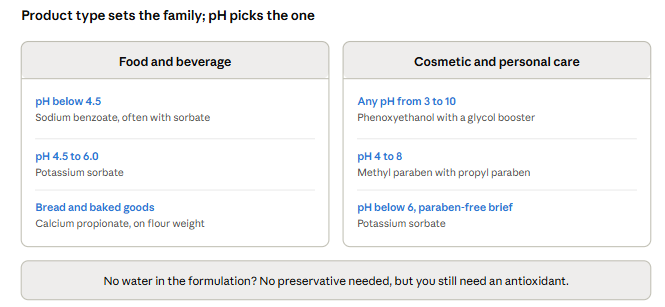
Product type comes first because it sets the legal frame. Phenoxyethanol and the parabens are cosmetic and pharmaceutical preservatives; calcium propionate is a food and feed preservative. Only sodium benzoate and potassium sorbate are routinely used in both.
pH comes second, and for three of the six it is decisive rather than advisory. The next section explains why.
The one concept that decides everything: pH
Three of the six preservatives here are weak acid preservatives: sodium benzoate, potassium sorbate and calcium propionate. For these, pH is not a detail to check at the end. It decides whether the preservative works at all.
A weak acid exists in water in two forms: the undissociated acid, which is electrically neutral, and the dissociated ion, which carries a charge. Only the undissociated form can cross a microbial cell membrane, get inside and acidify the cell. The charged ion cannot get in, so it does nothing.
What decides the split between the two is pH, and the relationship is steep. Each acid has a pKa, the pH at which exactly half of it is in the active form. Above the pKa, activity falls away quickly.
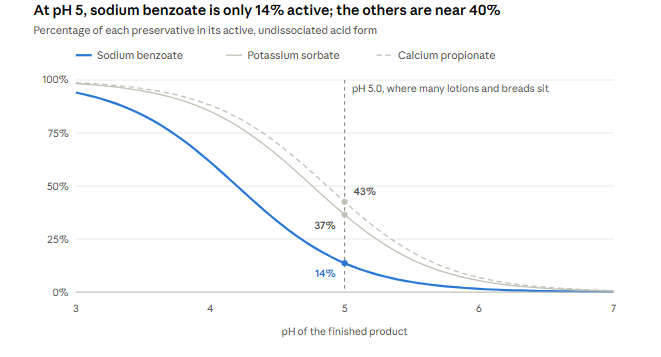
Three things follow from that curve.
Sodium benzoate needs a genuinely acidic product. Its pKa of 4.2 is the lowest of the three, so it fades first. Above pH 4.5 it is largely passengers.
Sorbate and propionate behave almost identically. Their pKa values differ by only 0.11, so the choice between them is made on spectrum and application, not on pH.
None of them work near neutral. By pH 6.5 all three are under 2% active. A shampoo at pH 6.5 or a lotion at pH 7 needs a preservative from the other family: parabens or phenoxyethanol, whose activity does not depend on this equilibrium.
This is also why measuring your final pH matters more than designing to one. A product formulated at pH 4.3 that drifts to pH 5.0 in storage has lost more than half of its working preservative without anything visible changing.
Phenoxyethanol
Phenoxyethanol is the workhorse of modern personal care preservation, and the main reason is the thing the weak acids cannot offer: it works across almost the whole pH scale.
What it is. A glycol ether, supplied as a clear oily liquid with a faint rose-like odour. It is not a food preservative.
pH window. Effective from roughly pH 3 to 10, with no meaningful loss of activity across that range. For a formulator this is the headline. A face cream at pH 5.5, a shampoo at pH 6.5 and an alkaline liquid soap at pH 9 can all use the same preservative at the same dose.
What it kills. Strong against bacteria, and notably effective against Gram-negative organisms including Pseudomonas, which is the hardest and most dangerous common contaminant in water-based cosmetics. It is weaker against yeasts and moulds, which is why it is rarely used alone.
Use level. Typically 0.5% to 1.0%. Most regulatory frameworks, including the EU Cosmetics Regulation, cap it at 1.0%. Below about 0.5% it is unreliable, so there is a narrow working band and little room to economise.
Temperature and addition. Phenoxyethanol is heat stable and will survive the hot phase, but normal practice is to add it during cool-down, below 40 to 45°C, along with fragrance and heat-sensitive actives. Water solubility is limited to around 2.7% at room temperature, which is comfortably above the dose you need, but at 1% in a large batch it is worth pre-mixing into a portion of the water phase or a glycol rather than pouring it in neat.
What it pairs with. Because of the gap on yeasts and moulds, phenoxyethanol is usually supplied or used in combination with ethylhexylglycerin or caprylyl glycol. Those are not preservatives in their own right in most frameworks; they are boosters that weaken microbial cell membranes so the phenoxyethanol works harder. The combination is what delivers genuinely broad spectrum protection.
Typical applications. Creams and lotions, shampoos and conditioners, liquid soaps and body washes, wet wipes, serums, and most leave-on skincare.
Methyl paraben and propyl paraben
These two belong together, because almost nobody uses either one alone. Understanding why explains how the paraben family works.
What they are. Esters of 4-hydroxybenzoic acid. The name tells you the alcohol it was made with: methyl, ethyl, propyl, butyl. As the chain gets longer, two things change in opposite directions.
- Longer chain = better against moulds and yeasts, but less water soluble
- Shorter chain = more water soluble and better against bacteria, but weaker on fungi
Methyl paraben is the short, water-soluble, bacteria-leaning end. Propyl paraben is longer, less soluble and better on fungi. Together they cover a spectrum neither covers alone, which is why the classic combination is 0.2% methyl paraben with 0.1% propyl paraben.
pH window. Effective from about pH 4 to 8. They hold up better than the weak acids at near-neutral pH, which is their real advantage over benzoate and sorbate. Above about pH 8.5 the phenolic group starts to ionise and activity falls away, so they are not suitable for strongly alkaline products.
Use level. In most frameworks, methyl paraben is permitted up to 0.4% on its own, with a 0.8% cap on total parabens. Propyl paraben is more tightly restricted: the EU limits propyl and butyl paraben to 0.14% combined, and bans them in leave-on products for the nappy area of children under three. Isopropyl, isobutyl, phenyl, benzyl and pentyl paraben are banned outright in the EU. Check the rules for the markets you actually sell into, since these limits differ between jurisdictions.
Temperature and addition. Parabens are heat stable and are normally added to the hot water phase, which is also the practical way to get them into solution. Methyl paraben dissolves slowly in cold water; propyl paraben barely does at all.
Getting them into solution is where most paraben problems start. Undissolved crystals do nothing, and they can reappear later as gritty specks in a finished cream. Dissolve them in the heated water phase with good agitation, or pre-dissolve in a small amount of propylene glycol or glycerin before adding. Hold the water phase at 70 to 80°C and confirm the solution is clear before you proceed.
Watch for inactivation. Non-ionic surfactants and some polymers can bind parabens and pull them out of the water phase, where the microbes are. A formulation heavy in polysorbates may need a higher dose, or a different preservative.
Typical applications. Creams, lotions, shampoos, make-up, pharmaceutical preparations, and as food additives E218 and E216 where permitted.
On paraben safety. Methyl and propyl paraben remain approved for cosmetic use in the EU, the US and most other markets at the limits above. The controversy that drove "paraben-free" marketing centred on a small and widely criticised 2004 study, and on the longer-chain esters that have since been restricted or banned. The decision to avoid them is usually a commercial one about consumer perception rather than a regulatory one. That is a legitimate reason to choose phenoxyethanol instead, but it is worth being clear with yourself about which kind of reason you are acting on.
Sodium benzoate
Sodium benzoate is cheap, food-approved and extremely effective, on one strict condition: your product has to be acidic. Not slightly acidic. Properly acidic.
What it is. The sodium salt of benzoic acid, supplied as a white powder or granules. It is highly water soluble, which is why the salt is used rather than benzoic acid itself.
pH window. This is the whole story. Benzoic acid has a pKa of 4.2, so it is half active at pH 4.2 and falls away fast above that. Useful activity runs to about pH 4.5, with the optimum between pH 2.5 and 4.0. By pH 5 only about 14% of what you added is in the active form, and by pH 6 it is under 2%.
If your product sits above pH 4.5, sodium benzoate is close to decorative. It will appear on your label and show up on an assay, and it will not protect the batch.
What it kills. Yeasts and moulds primarily, with useful activity against many bacteria. It is the standard choice for acidic beverages and sauces.
Use level. Typically 0.05% to 0.1% in food, within whatever your national standard permits, and up to 0.5% in cosmetics in most frameworks. More is not better: at higher levels it can contribute a noticeable astringent or chemical note.
Temperature. Heat stable. It survives pasteurisation and normal processing, and can be added to either the hot or cold phase. Add it as a solution rather than dry powder so it disperses evenly.
Typical applications. Carbonated and still soft drinks, fruit juices, pickles, sauces, salad dressings, jams, and acidic cosmetics such as shampoos, mouthwash and some cleansers.
The benzene caution. Sodium benzoate and ascorbic acid (vitamin C) in the same product can react to form small amounts of benzene, a known carcinogen. The reaction is driven by heat, light and trace metal ions, particularly copper and iron. If your formulation contains both, which is common in fruit-flavoured drinks, either reformulate to avoid the combination, keep storage cool and dark, or add a chelating agent such as EDTA to tie up the metal catalysts. This is a real and documented issue that has caused product withdrawals, not a theoretical one.
Potassium sorbate
Potassium sorbate is sodium benzoate's close relative, with one practical difference that often decides between them: it keeps working further up the pH scale.
What it is. The potassium salt of sorbic acid, supplied as white granules or powder, highly soluble in water.
pH window. Sorbic acid has a pKa of 4.76, half a unit above benzoic acid. That half unit matters more than it sounds. Useful activity extends to around pH 6.0 to 6.5, with the optimum below pH 5.0. At pH 5, roughly 37% is still in the active form, against 14% for benzoate.
That is the practical rule of thumb: below pH 4, either works; between pH 4.5 and 6, reach for sorbate.
What it kills. Strongly antifungal, so yeasts and moulds are its target. It is comparatively weak against bacteria, which is the trade-off against benzoate and the reason the two are so often used together.
Use level. Typically 0.05% to 0.3%, depending on the product and the pH. At the upper end of its pH range you need the upper end of the dose, because less of what you add is active.
Temperature and stability. Heat stable in normal processing, but sorbic acid is more prone to oxidation than benzoic acid. Prolonged heating, exposure to air, or the presence of iron or copper can cause gradual degradation and, in some products, a yellow-brown discolouration. Store it dry and sealed, and avoid holding finished product hot for long periods.
Typical applications. Cheese, yoghurt, wine, baked goods, dried fruit, beverages, sauces and dips. In personal care it appears in low-pH cleansers and in natural-positioned products where parabens have been ruled out on marketing grounds.
Calcium propionate
Calcium propionate is the specialist of the six. It does one job, in one industry, and it does it better than anything else: it keeps bread from going mouldy and ropy.
What it is. The calcium salt of propionic acid, a white powder. Propionic acid occurs naturally in Swiss cheese, where the bacteria that make the holes also make the acid.
pH window. Propionic acid has a pKa of 4.87, so on paper it behaves much like sorbic acid. Useful activity extends to about pH 5.5 to 6.0, with the optimum below pH 5.5. That happens to be where bread crumb sits, which is the reason this particular preservative found this particular home.
What it kills. Moulds, and critically rope-forming Bacillus bacteria. Rope is the defect where bread develops a sticky, stringy, sweet-smelling crumb a day or two after baking, caused by Bacillus subtilis surviving the bake as spores. It is a serious problem in warm, humid climates, and propionate is the standard defence. Calcium propionate has little effect on yeasts, which is exactly what you want in a dough that has to rise.
Use level. Typically 0.1% to 0.4% on flour weight. Note the basis: bakery dosing is calculated on flour, not on total dough or finished loaf, which is a common source of error when converting a recipe.
Temperature. Heat stable and survives baking intact. It is added with the dry ingredients at the mixing stage.
Why calcium rather than sodium. Calcium propionate is preferred in bread because the calcium contributes to dough strength and the product carries no added sodium. Sodium propionate is generally used in cakes and chemically leavened products instead, because calcium ions interfere with chemical raising agents.
Typical applications. Bread and rolls, tortillas and flatbreads, baked goods generally, processed cheese, and animal feed as a mould inhibitor.
One trade-off to know about. At the upper end of the dose range, propionate can slow yeast activity enough to affect proofing time. If you are dosing near 0.4% and your dough suddenly needs longer to rise, that is the likely cause rather than the yeast.
The six side by side
Working pH | Best below | Strongest against | Typical dose | Add at | Main uses | |
|---|---|---|---|---|---|---|
Phenoxyethanol | 3 to 10 | no limit in range | Bacteria, especially Pseudomonas | 0.5 to 1.0% | Cool-down, below 40 to 45°C | Creams, lotions, shampoos, wipes |
Methyl paraben | 4 to 8 | pH 7 | Bacteria, some fungi | 0.1 to 0.4% | Hot water phase, 70 to 80°C | Cosmetics, pharma |
Propyl paraben | 4 to 8 | pH 7 | Moulds and yeasts | 0.05 to 0.14% | Hot water phase, 70 to 80°C | Cosmetics, pharma |
Sodium benzoate | below 4.5 | pH 4.0 | Yeasts, moulds, many bacteria | 0.05 to 0.5% | Either phase, as solution | Acidic drinks, sauces, pickles |
Potassium sorbate | below 6.0 to 6.5 | pH 5.0 | Yeasts and moulds | 0.05 to 0.3% | Either phase, as solution | Cheese, wine, baked goods, low-pH cosmetics |
Calcium propionate | below 5.5 to 6.0 | pH 5.5 | Moulds and rope Bacillus | 0.1 to 0.4% on flour | Dry mix stage | Bread and baked goods |
Read the pH column first. It eliminates more options than anything else, and no amount of extra dose compensates for being outside the window.
Dose ranges are starting points for formulation trials, not specifications. Confirm the final level by challenge testing, and work within the legal limits for the markets you sell into.
Combining preservatives
Single preservatives have gaps. Every one of the six above is better at some organisms than others, and a formulation left open on one flank will eventually be found out.
The principle is called hurdle technology: instead of relying on one barrier, put up several smaller ones. A microbe that can survive any one hurdle rarely survives the combination. Your hurdles are not only preservatives; low pH, low water activity, refrigeration and good packaging all count.
Combinations that work
Sodium benzoate with potassium sorbate. The most common pairing in acidic foods and drinks. Benzoate brings the stronger antibacterial action, sorbate the stronger antifungal action, and both need the same acidic conditions. Typically 0.05% of each rather than 0.1% of either.
Methyl paraben with propyl paraben. The classic cosmetic pair, usually around 0.2% methyl to 0.1% propyl, covering bacteria and fungi across pH 4 to 8.
Phenoxyethanol with ethylhexylglycerin or caprylyl glycol. Fills phenoxyethanol's weakness on yeasts and moulds. The partner is a booster rather than a preservative in its own right; it disrupts cell membranes so the phenoxyethanol reaches its target.
Any preservative with a chelating agent. Adding 0.1% EDTA or a similar chelator binds the metal ions that bacteria need and strips protective biofilms. It is not a preservative, but it can make a marginal system reliable, and it is one of the cheapest improvements available.
What not to do
Do not simply stack preservatives and assume the problem is covered. Some combinations are antagonistic, some cause precipitation or discolouration, and every addition is another ingredient that can irritate skin or trigger a label objection. Two well-chosen preservatives at sensible levels beat four chosen out of anxiety.
Getting the addition right
The right preservative added badly protects nothing. Four things go wrong most often.
1. Added at the wrong temperature
Parabens go into the hot water phase at 70 to 80°C, both because they are heat stable and because that is the only practical way to dissolve them. Phenoxyethanol goes in during cool-down below 40 to 45°C. Benzoate, sorbate and propionate tolerate either.
Adding a preservative to a batch that is still at 80°C when it belongs in cool-down wastes some of it to evaporation. Adding parabens to a cold batch leaves undissolved crystals that do nothing at all.
2. Not properly dissolved
A preservative only works where it dissolves. An undissolved crystal is inert, and worse, it means the rest of the batch is under-dosed relative to what the paperwork says.
- Parabens: dissolve in the heated water phase with agitation, or pre-dissolve in propylene glycol or glycerin
- Phenoxyethanol: pre-mix into part of the water phase or a glycol
- Benzoate, sorbate, propionate: dissolve in water first and add as a solution, never as dry powder into a finished batch
Confirm the solution is clear before moving on.
3. Added in the wrong order
Add the preservative before any final pH adjustment, then measure pH again after everything is in. This is the step people skip. A cream formulated at pH 5.0 that drifts to 5.8 after the last addition has quietly moved a sorbate-preserved product to the edge of its window.
4. Partitioned into the oil phase
Microbes grow in water, so the preservative must be in the water phase to meet them. In an emulsion, oil-soluble preservatives partition into the oil droplets where they do no good. Propyl paraben is more oil-soluble than methyl paraben, which is part of why the pair is used rather than propyl alone. Formulations with a large oil phase or heavy non-ionic surfactant loading may need a higher dose to keep enough preservative in the water.
Where water goes, preservative must follow. If you dilute a concentrate, add water to a formula, or let condensation collect in a container, you have changed the preservation maths. Recalculate rather than assuming the original dose still holds.
Proving it works
Everything above tells you which preservative is likely to work. Only one thing tells you whether it does: a challenge test.
Preservative Efficacy Testing, also called challenge testing, deliberately inoculates your finished product with a standard panel of organisms, then counts how many survive over time. The usual panel is Staphylococcus aureus, Pseudomonas aeruginosa, Escherichia coli, Candida albicans and Aspergillus brasiliensis: two bacteria that cause infections, one that signals faecal contamination, a yeast and a mould.
Counts are taken at intervals across 28 days, and the product passes if the organisms are reduced by a defined amount within a defined time. The standard methods are ISO 11930 for cosmetics and the pharmacopoeial methods for pharmaceuticals.
Test the finished product in its final packaging, not a laboratory beaker of the formula. Packaging matters: a jar that a consumer dips fingers into faces a completely different challenge from an airless pump, and a preservative system adequate for one may not be adequate for the other.
Re-test when anything changes. A new fragrance, a different thickener, a switch of supplier for a raw material, a change in pH, a new pack format: each is a reason to re-validate. Preservation is a property of the whole formulation, not of the preservative alone.
If you do not have access to a microbiology laboratory, this is worth outsourcing. It is the only step that converts a reasonable choice into evidence, and it is what a regulator or a serious customer will ask to see.
Frequently asked questions
Which preservative should I use for my product's pH?
Below pH 4.5, sodium benzoate or potassium sorbate. Between pH 4.5 and 6, potassium sorbate or calcium propionate, or move to parabens. Between pH 6 and 8, parabens or phenoxyethanol. Above pH 8, phenoxyethanol. Phenoxyethanol works across the widest range, from about pH 3 to 10.
What is the difference between sodium benzoate and potassium sorbate?
Benzoate is the stronger antibacterial, sorbate the stronger antifungal, and sorbate keeps working at a higher pH. Benzoate fades above pH 4.5; sorbate holds to around pH 6. They are often used together at low levels because their strengths are complementary.
Are parabens safe to use?
Methyl and propyl paraben remain approved for cosmetic use in the EU, the US and most other markets, at defined limits. The EU restricts propyl and butyl paraben to 0.14% combined and has banned several longer-chain esters. Most decisions to avoid parabens are commercial, driven by consumer perception rather than regulatory restriction.
Why did my preservative stop working?
The usual causes, in order of likelihood: the pH drifted out of the preservative's window; the preservative was never fully dissolved; the formulation changed and was not re-tested; or contamination entered after production through packaging or handling. Check pH first, because it is both the most common cause and the easiest to measure.
How much preservative should I use?
Start from the typical ranges in the comparison table, then confirm by challenge testing. Doubling the dose does not fix a preservative that is outside its pH window, and it may breach a legal limit.
Can I use a natural preservative instead?
Potassium sorbate and sodium benzoate both occur naturally and are widely accepted in natural-positioned products. Options marketed as fully natural, such as ferment filtrates and botanical extracts, vary considerably in reliability and usually need challenge testing to confirm they work at all. Treat the marketing claim and the microbiological performance as separate questions.
Do I need a preservative if my product has no water?
Anhydrous products such as oils, balms and waxes do not support microbial growth and generally do not need a preservative. They do need an antioxidant to prevent rancidity, which is a different problem. The moment water can get in, through a wet finger in a jar or condensation in a container, the calculation changes.
Does calcium propionate work in cosmetics?
In practice, no. It is a food and feed preservative, and most cosmetics sit at a pH where it is already weak and in a format where parabens or phenoxyethanol are far better suited.
Source your preservatives from Multikem
Multikem Enterprises Ltd supplies all six preservatives covered here: phenoxyethanol, methyl paraben, propyl paraben, sodium benzoate, potassium sorbate and calcium propionate, along with the chelating agents and pH adjusters that go with them.
Consistent grades matter more for preservatives than for almost anything else in your formula. A change in purity or particle size changes how readily the material dissolves, and a preservative that does not dissolve does not preserve. Buying the same specification batch after batch is what lets you trust a validated dose.
We also provide the technical support to go with it. Tell us your product type, your target pH and your process temperatures, and we will help you narrow the choice before you commit to a trial.
Talk to our team:
- Mobile: +256 755 838 813
- Email: multikementerpriseslimited@gmail.com
- Web: www.multikemltd.com
Quality Ingredients. Stronger Solutions.
This guide is general technical information, not a formulation specification. Confirm every preservative choice by challenge testing your own finished product, and comply with the regulatory limits in force in the markets where you sell.