

Introduction
Pool water that looks clean can still be unsafe to swim in, and water that looks cloudy is often only one chemical away from being perfect. The difference is not luck. It is a short, repeatable routine built on six products.
This guide explains what each of those products does, when to reach for it, and how the six work together. Whether you run a hotel pool, a school pool, an apartment block or a pool at home, the chemistry is the same.
Why pool water treatment matters
Untreated pool water is a health risk long before it looks dirty. Warm, sunlit water with a steady supply of sweat, sunscreen, soil and organic matter is an ideal environment for bacteria and for the organisms behind eye, ear, skin and stomach infections. A pool that is busy on a hot afternoon can lose its entire chlorine residual in a few hours.
There is a second cost that pool owners notice later. Water that sits outside its correct chemical range quietly attacks the pool itself:
- Water that is too acidic corrodes pump impellers, heater elements, ladders and handrails, etches plaster and fades liners
- Water that is too alkaline or too hard forms scale on tiles, waterline surfaces and inside pipework and heaters, and makes chlorine work less effectively
- Water left unbalanced for weeks grows algae, which stains surfaces and blocks filters
The repair bill for a corroded heater or a re-plastered pool runs well beyond a year of chemicals. Treating water properly is the cheapest part of owning a pool.
The three jobs of pool water treatment
Every product in this guide does one of three jobs. Knowing which job you are doing tells you which container to open.
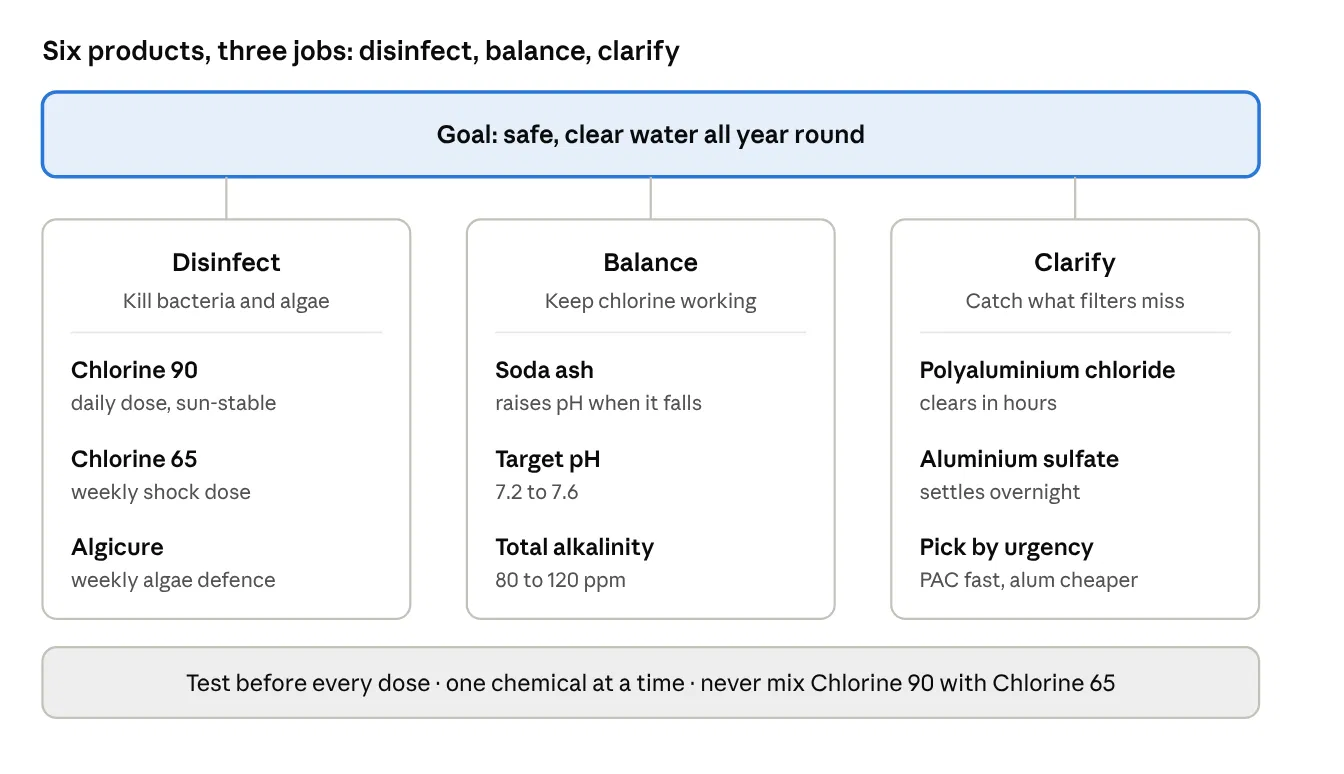
The order matters. Disinfection is what keeps swimmers safe, but chlorine only works properly in balanced water, which is why soda ash deserves as much attention as the chlorine itself. Clarity is the job people actually notice.
Chlorine 90: your everyday sanitizer
Chlorine 90 is trichloroisocyanuric acid (TCCA), a stabilized chlorine donor carrying roughly 90% available chlorine. It is the workhorse of routine pool care, supplied as granules or as slow-dissolving tablets.
Why "stabilized" matters on the equator
TCCA releases cyanuric acid along with its chlorine. Cyanuric acid acts as a sunscreen for chlorine: it binds the chlorine loosely and shields it from ultraviolet light. Unprotected chlorine in an uncovered pool under strong sun can be destroyed within hours, and Uganda sits on the equator with high UV all year.
That makes Chlorine 90 the sensible default for any outdoor pool here. Your chlorine stays in the water long enough to do its job instead of burning off by midday.
How to use it
- Tablets go in a floating dispenser, a skimmer basket or an in-line feeder for steady, hands-off dosing
- Granules are pre-dissolved in a bucket of water, then poured slowly around the pool with the pump running
- Dose in the evening so the chlorine has the night to work before the sun returns
As a working figure, about 1.1 g of Chlorine 90 per cubic meter of water raises free chlorine by roughly 1 ppm. A 50 m³ pool therefore needs around 55 g to lift free chlorine by 1 ppm. Daily demand depends on sunlight, temperature and how many people swim, so test before you dose rather than working to a fixed amount.
The one thing to watch
Cyanuric acid does not evaporate or get used up. It accumulates every time you add stabilized chlorine. Once it climbs past roughly 100 ppm, chlorine becomes sluggish and your readings stop matching what the water is actually doing. The only practical cure is to drain part of the pool and refill with fresh water.
Test cyanuric acid every month or two. If it is drifting high, switch some of your dosing to Chlorine 65, which adds no stabilizer at all.
Chlorine 65: your shock treatment
Chlorine 65 is calcium hypochlorite, carrying around 65% available chlorine. It is unsterilized and fast-acting, which makes it the right tool for the moments when you need chlorine to hit hard and hit now.
When to reach for it
- Shocking a pool after heavy bather load, a rainstorm or a party
- Reopening a pool that has sat unused
- Clearing an algae bloom, alongside an algaecide
- Breaking down chloramines, the combined chlorine responsible for the sharp "chlorine smell" and stinging eyes
- Routine dosing in indoor pools, where there is no sunlight to destroy chlorine and no need for stabilizer
How to use it
Always pre-dissolve Chlorine 65 in a clean bucket of water, then pour the solution slowly around the pool edge with the pump running. Never broadcast the granules dry across the pool: undissolved granules sink and can bleach or damage the pool floor.
About 1.5 g per cubic meter raises free chlorine by roughly 1 ppm. A typical shock aims for 5 to 10 ppm, so a 50 m³ pool needs in the region of 400 to 750 g. Shock in the evening, run the filter overnight, and keep swimmers out until free chlorine falls back below 3 ppm.
Two side effects to plan for
Chlorine 65 is strongly alkaline and will push your pH up, so check pH the morning after shocking and correct it if needed. It also adds calcium to the water. In an area with hard fill water, repeated heavy use can drive calcium hardness high enough to cause cloudiness and scale, which is another reason to alternate it with Chlorine 90 rather than relying on it alone.
Chlorine 90 vs Chlorine 65: which should you use?
Most well-run pools use both. They do different jobs, and the question is not which is better but which belongs in today's bucket.
Parameter | Chlorine 90 (TCCA) | Chlorine 65 (Calcium hypochlorite) |
|---|---|---|
Available chlorine | ~90% | ~65% |
Stabilized against sunlight | Yes, releases cyanuric acid | No |
Effect on pH | Lowers it (acidic) | Raises it (alkaline) |
Speed of action | Slow, sustained release | Fast, immediate |
Best for | Daily and weekly sanitizing, outdoor pools | Shock dosing, reopening, algae blooms, indoor pools |
Adds to the water | Cyanuric acid, which accumulates | Calcium hardness |
Typical form | Tablets and granules | Granules |
The practical program: run Chlorine 90 as your day-to-day sanitizer to hold a steady residual, and bring in Chlorine 65 weekly or fortnightly to shock. The two balance each other neatly, since one gently lowers pH while the other raises it, and only one of them adds stabilizer.
Store and handle them as two completely separate chemicals. The safety section below explains why this matters more than any other rule in this guide.
Soda ash: the chemical that makes your chlorine work
Soda ash (sodium carbonate) raises pH, and pH decides how much of your chlorine is actually doing anything.
Chlorine in water exists in two forms, and only one of them is a strong disinfectant. The balance between them shifts with pH:
- At pH 7.2, roughly two thirds of your free chlorine is in the active form
- At pH 7.5, about half
- At pH 8.0, only about a quarter
That is the whole argument for pH control. A pool sitting at pH 8.2 can show a perfectly respectable free chlorine reading on a test kit while disinfecting at a fraction of the rate the owner assumes.
What low pH does to a pool
Acidic water below pH 7.0 corrodes metal fittings, pump components and heater elements, etches plaster and grout, fades and wrinkles vinyl liners, and stings swimmers' eyes. It also burns through chlorine faster. Rain, which is naturally slightly acidic, pushes outdoor pools downward over time, and so does Chlorine 90.
How to dose it
Soda ash raises pH quickly and total alkalinity more gently. As a starting point, roughly 4 to 6 g per cubic meter lifts pH by about 0.2, though the exact response depends on your current alkalinity.
- Test pH and total alkalinity before you touch anything
- Correct total alkalinity first, then pH; alkalinity is the buffer that stops pH bouncing around, so fixing it in the wrong order means doing the job twice
- Pre-dissolve the soda ash in a bucket of water
- Add about a quarter of what you calculated, with the pump running
- Circulate for four to six hours, then retest before adding more
Overshooting is easy and annoying to reverse, because bringing pH back down calls for an acid. Creep up on the target.
Soda ash or bicarbonate? Soda ash moves pH a lot and alkalinity a little. Sodium bicarbonate does the opposite. If your pH is fine but alkalinity is low, bicarbonate is the better choice. If pH is low, reach for soda ash.
Aluminium sulfate: for water that is clean but cloudy
Aluminium sulfate, known in the trade as alum, is a flocculant. It is what you use when the chemistry tests fine but the water still looks milky or dull.
Cloudiness is usually caused by particles far too small for a sand filter to catch: fine dust, pollen, dead algae, skin cells and sunscreen residue. They simply pass through the filter and back into the pool, over and over.
Alum fixes this by changing the particles rather than the filter. Dosed into the water, it forms a gelatinous aluminum hydroxide floc that carries a charge opposite to the suspended particles. The particles stick to it, clump into masses heavy enough to sink, and settle on the pool floor where you can vacuum them out.
How to use it
This is a slow, deliberate treatment, and the pool is out of use for a day.
- Check that pH sits between about 6.5 and 8.0, the window where alum flocs properly
- Pre-dissolve the alum and distribute it evenly around the pool with the pump running for about 30 minutes
- Switch the pump off and leave the water completely undisturbed for 8 to 12 hours, usually overnight
- The next morning, vacuum the settled floc slowly to waste, not through the filter
- Top the pool back up, then retest and rebalance
Step four is the one people get wrong. Vacuuming through the filter pushes the floc straight back into circulation and undoes the whole treatment. If your system has no waste setting, use a submersible pump or a vacuum that discharges outside the pool.
Alum lowers pH as it works, so expect to add soda ash afterwards.
Polyaluminium chloride: the faster, lighter clarifier
Polyaluminium chloride, usually shortened to PAC, is a pre-hydrolyzed aluminium coagulant. It does the same job as alum but is already partly reacted before it reaches the water, which makes it quicker, gentler on your chemistry and effective at much lower doses.
Where it wins over alum
- Lower dose for the same result, so less product per treatment
- Wider pH tolerance, so it keeps working when alum would struggle
- Barely moves your pH and alkalinity, meaning far less rebalancing afterwards
- Faster flocs, often clearing water in a few hours instead of overnight
- Less sludge on the pool floor, so vacuuming is quicker and you lose less water
Two ways to use it
As a clarifier, through the filter. Add a small dose with the pump running and leave the filtration system on. PAC binds fine particles into clumps just large enough for the filter to catch, and the water clears over several hours. Backwash afterwards. This is the routine approach for water that is slightly dull rather than badly clouded.
As a flocculant, settling to the floor. For heavier cloudiness, dose at the higher rate, run the pump briefly to distribute, then switch it off and let everything settle before vacuuming to waste, exactly as with alum.
Because dose rates differ substantially between PAC grades and concentrations, work from the rate on your product label rather than a general figure. Our team can advise on the right dose for your specific grade and pool volume.
Aluminium sulfate vs polyaluminium chloride
Parameter | Aluminium sulfate (alum) | Polyaluminium chloride (PAC) |
|---|---|---|
Dose needed | Higher | Lower for the same result |
Working pH range | Narrow, around 6.5 to 8.0 | Wide |
Effect on pH and alkalinity | Lowers both noticeably | Minimal |
Speed | Settles overnight, 8 to 12 hours | Often clears within hours |
Sludge produced | More | Less |
Method | Pump off, settle, vacuum to waste | Either through the filter or settle and vacuum |
Best for | Heavy cloudiness, budget treatment of large volumes | Routine clarity, fast turnaround, pools in daily use |
If a hotel or club pool needs to be swimmable tomorrow morning, PAC is usually the better call. If you are recovering a badly neglected pool and cost per cubic meter matters more than speed, alum does the job well.
Algicure: stopping algae before it starts
Algicure is an algaecide, and its real value is preventive. By the time a pool has turned green, you are no longer doing pool maintenance; you are doing pool recovery, and it costs considerably more in chemicals, labor and downtime.
Why chlorine alone is not enough
Algae spores arrive continuously on wind, rain, swimwear and garden debris. Chlorine does kill algae, but it is simultaneously being consumed by sweat, sunscreen, urine, leaves and sunlight. Any afternoon where chlorine dips, after a heavy rainstorm, a crowded weekend or a pump failure, is an opening. In warm equatorial water, a bloom can take hold within a day.
An algaecide works through a different mechanism from chlorine, typically by disrupting algae cell membranes or blocking their metabolism. It acts as a second line of defense that keeps working during the windows when chlorine is stretched thin.
Prevention versus treatment
For prevention, add a maintenance dose on a regular weekly schedule, ideally right after your weekly shock, when the water is clean and the algaecide is not competing with a high chlorine load. Keep it routine. An algaecide you remember only when the water looks green is not doing the job it is for.
For an existing bloom, the algaecide is one step in a sequence:
- Brush every surface vigorously, especially steps, corners and shaded areas. Algae clings to surfaces behind a protective layer, and brushing breaks it open so chemicals can reach it
- Shock hard with Chlorine 65
- Dose Algicure at the treatment rate on the label
- Run the filter continuously for 24 to 48 hours
- Vacuum the dead algae, which settles as a grey or brown deposit
- Clear the haze with PAC or alum, since dead algae leaves water cloudy
- Rebalance pH and alkalinity, and backwash the filter
Use the dose rates printed on your Algicure label. Treatment rates are typically several times the preventive rate, and overdosing some algaecide chemistries can cause foaming or staining.
Target water chemistry at a glance
Every decision in pool care comes back to these numbers. Print this table and keep it with your test kit.
Parameter | Target range | If it is low | If it is high | Test how often |
|---|---|---|---|---|
Free chlorine | 1 to 3 ppm domestic, 2 to 4 ppm public | Add Chlorine 90 or Chlorine 65 | Stop dosing and let it fall; keep swimmers out above 3 ppm | Daily for public pools, two or three times weekly at home |
Combined chlorine | Below 0.5 ppm | No action needed | Shock with Chlorine 65 | Weekly |
pH | 7.2 to 7.6 | Add soda ash | Add a pH reducer | Daily for public pools, two or three times weekly at home |
Total alkalinity | 80 to 120 ppm | Add sodium bicarbonate | Add a pH reducer in small doses | Weekly |
Calcium hardness | 200 to 400 ppm | Add a calcium hardness increaser | Dilute with fresh water | Monthly |
Cyanuric acid | 30 to 50 ppm, never above 100 | Switch dosing toward Chlorine 90 | Partially drain and refill | Monthly |
A note on reading this table: correct total alkalinity first, then pH, then chlorine. Alkalinity is what holds pH steady, so adjusting pH while alkalinity sits outside its range means watching your careful work drift back within days.
Test in the morning before the sun is high, and before anyone swims. Readings taken on a busy afternoon tell you what the pool has already lost, not what it started with.
A pool maintenance routine that works
Consistency beats intensity. Fifteen minutes on the right days prevents the weekend-long rescue operations.
Daily
- Empty skimmer and pump baskets
- Skim floating debris off the surface
- Test free chlorine and pH, and top up chlorine as needed
- Run the filter long enough to turn the water over at least once, typically 6 to 8 hours
Weekly
- Brush the walls, floor, steps and waterline, paying attention to shaded corners
- Vacuum the floor
- Test total alkalinity and correct it, then recheck pH
- Shock with Chlorine 65
- Add the maintenance dose of Algicure after shocking
- Backwash the filter if pressure has risen noticeably above its clean reading
Monthly
- Test calcium hardness and cyanuric acid
- Deep clean the skimmer, pump basket and filter
- Inspect the pump, seals and any heating equipment
- Clear cloudiness with PAC or alum if the water has lost its sparkle
The order to add chemicals
Never add two treatment chemicals at the same time or in the same bucket. Work through them one at a time, with the pump running and enough circulation between each:
- Balance total alkalinity, then wait and retest
- Correct pH with soda ash, then wait and retest
- Add chlorine
- Add algaecide, once chlorine has had time to circulate
- Add flocculant or clarifier last, as a separate treatment on its own day
Allow at least four to six hours of circulation between steps. The temptation to do everything in one evening is exactly how people end up with cloudy water, wasted chemicals and, in the worst cases, a dangerous reaction.
Safety, handling and storage
Pool chemicals are effective because they are reactive. Treated with respect they are entirely routine; treated casually they cause serious injuries every year.
The rule that matters most
Never mix Chlorine 90 and Chlorine 65. Not in a bucket, not in a feeder, not in a storage drum, and not with the same scoop.
Trichloroisocyanuric acid and calcium hypochlorite react violently with each other. Combining them, even in small quantities and even as dry residue left in a shared container, can generate intense heat, toxic gas, fire or an explosion. This has destroyed pump rooms and injured people who believed they were simply handling two kinds of chlorine.
Give each product its own clearly labelled scoop and its own storage shelf. If you switch from one to the other in a floater or feeder, rinse and dry it thoroughly first.
Handling
- Always add chemical to water, never water to chemical. Adding water to concentrated product can cause a violent reaction that sprays the contents back at you
- Wear chemical-resistant gloves and eye protection every time
- Mix outdoors or in a well-ventilated space, and stand upwind of the bucket
- Avoid breathing dust or fumes
- Use a separate, dedicated bucket for each chemical
- Never combine any two pool chemicals in one container, including an apparently empty one
- Keep chlorine products well away from acids; together they release chlorine gas
Storage
- Cool, dry, shaded and well ventilated, out of direct sunlight
- In the original closed container, with the label intact and legible
- Off the floor, protected from flooding and from damp, since moisture degrades chlorine and can start a reaction
- Away from fuels, oils, solvents, fertilizers and anything flammable, because chlorine products are strong oxidizers
- Locked away from children and animals
- Keep the Safety Data Sheet for each product where staff can find it
If something goes wrong
Flush skin or eyes with clean running water for at least 15 minutes and seek medical attention. If chemicals are inhaled, move the person into fresh air immediately. If two chemicals have been mixed accidentally, evacuate the area, do not attempt to clean it up, and call emergency services. Show the Safety Data Sheet to the treating medical team.
Troubleshooting common pool problems
Symptom | Most likely cause | What to do |
|---|---|---|
Water has turned green | Algae bloom after chlorine dropped | Brush all surfaces, shock with Chlorine 65, dose Algicure, filter continuously, then clear the haze with PAC |
Water is cloudy or milky but chemistry tests fine | Particles too fine for the filter to catch | Treat with PAC for a fast result, or alum if you can take the pool offline overnight |
Strong chlorine smell and stinging eyes | Chloramines, which means too little free chlorine, not too much | Shock with Chlorine 65 to break them down, and check pH |
Chlorine disappears within hours | No stabilizer in an outdoor pool, or a very heavy organic load | Switch to Chlorine 90 and check cyanuric acid sits in the 30 to 50 ppm range |
Chlorine reads fine but the pool still looks poor | pH too high, so most of the chlorine is inactive | Bring pH back to 7.2 to 7.6 |
Chlorine will not hold even after shocking | Cyanuric acid above 100 ppm | Partially drain and refill with fresh water |
Scale on tiles and waterline, cloudy water | Calcium hardness or pH too high | Lower pH, and dilute with fresh water if hardness is high |
Corroded fittings, etched plaster, faded liner | pH or alkalinity too low | Raise alkalinity with bicarbonate, then pH with soda ash |
Eye and skin irritation with no chlorine smell | pH outside the comfortable range | Correct pH to 7.2 to 7.6 |
Pool cleared, then clouded again days later | Dead algae was never filtered out, or the filter needs backwashing | Backwash, then treat with PAC and maintain a steady chlorine residual |
Frequently asked questions
What is the difference between Chlorine 90 and Chlorine 65?
Chlorine 90 is stabilized trichloroisocyanuric acid with about 90% available chlorine. It dissolves slowly and resists sunlight, which makes it right for daily sanitizing in outdoor pools. Chlorine 65 is calcium hypochlorite with about 65% available chlorine. It is un stabilized and fast-acting, which makes it right for shock treatment. Most pools use both, and the two must never be mixed or stored together.
How much chlorine should a swimming pool have?
Free chlorine should sit between 1 and 3 ppm in a domestic pool, and between 2 and 4 ppm in a public or commercial pool. Combined chlorine should stay below 0.5 ppm. Test at least two or three times a week at home, and daily for a public pool.
Why is my pool still green even though I added chlorine?
Usually one of three reasons. pH may be too high, leaving most of your chlorine inactive. Cyanuric acid may have climbed above 100 ppm, which makes chlorine sluggish. Or the dose was simply too small for an established bloom. Brush the surfaces first, shock with Chlorine 65, add an algaecide, and run the filter continuously.
How do I clear cloudy pool water?
If your chemistry tests normal, the cloudiness is fine suspended particles that pass straight through your filter. Treat with polyaluminium chloride for a result within hours, or aluminium sulfate if you can leave the pump off overnight and vacuum the settled floc to waste the next morning.
How often should I shock my pool?
Once a week for most pools, and additionally after heavy use, heavy rain, or any period when chlorine has been allowed to fall. Shock in the evening and run the filter overnight.
Can I swim straight after adding chemicals?
No. Wait until free chlorine has fallen back below 3 ppm and pH is between 7.2 and 7.6, which usually means at least 8 hours after shocking. After a flocculant treatment, wait until the floc has been vacuumed out and the water rebalanced.
Why does my pool smell strongly of chlorine?
Counter-intuitively, that smell means too little free chlorine rather than too much. It comes from chloramines, formed when chlorine combines with sweat, body oils and urine. Shock the pool with Chlorine 65 to break them down.
What does soda ash do in a swimming pool?
Soda ash raises pH and, to a lesser extent, total alkalinity. It is used to correct acidic water, which otherwise corrodes equipment, etches surfaces, irritates swimmers and destroys chlorine faster.
Do I really need an algaecide if I am chlorinating properly?
It is strongly recommended. Chlorine fights many demands at once and will occasionally dip below the level that holds algae back, particularly after heavy rain or heavy use. A weekly maintenance dose of Algicure is far cheaper than recovering a green pool.
Source your pool chemicals from Multikem
Multikem Enterprises Ltd supplies all six products covered in this guide: Chlorine 90, Chlorine 65, soda ash, aluminium sulfate, polyaluminium chloride and Algicure. We serve hotels, schools, apartment blocks, clubs and private pool owners across Uganda.
Buying from one supplier makes the program easier to run. You get consistent grades batch to batch, so your dose rates stay reliable, and you get technical guidance on which product to use when rather than a shelf of containers and a guess.
Talk to our team about your pool:
- Call or WhatsApp: +256 755 838 813
- Email: multikementerpriseslimited@gmail.com
- Product Category: https://www.multikemltd.com/shop/category/swimming-pool-chemicals-21
Tell us your pool volume and your current test readings, and we will help you work out exactly what you need and how much of it.